SMT Lens Feeding & Automation Glossary | JHIMS

A working glossary of SMT lens feeding: 30 terms, plus the throughput, rejection and changeover numbers behind them and how to verify each figure on your lens.
Glossary

SMT Lens Feeding & Automation Glossary

30 essential terms every SMT engineer, production manager and procurement professional should know — defined, grouped and translated into the numbers that decide throughput, yield and payback.

Direct answer: Lens feeding is the step that delivers optical lenses to a pick-and-place machine at the right orientation, at the right speed, one at a time. In a manual cell an operator loads trays and places lenses by hand, which typically runs 800–1,200 UPH with a 5–15% rejection rate and 15–30 minutes of changeover between lens types. A vibratory bowl feeder with dual-frequency drives, PLC recipe recall and fiber-optic sensing feeds 3,600–7,200 UPH per channel, holds rejection under 0.5%, and changes lens type in under 5 minutes. This glossary defines the 30 terms that appear in feeder specifications, quotes and acceptance reports, and explains which numbers actually decide throughput, yield and payback.

Key Takeaways

  • 130 Terms Explained
  • 23,600–7,200 UPH per Channel
  • 3<0.5% Rejection Target
  • 4<5 min Changeover

What Lens Feeding Means in an SMT Line

An SMT line prints solder paste, inspects the deposit, places components, then reflows. Lenses are a separate component family — LED, backlight, optical and micro lenses, mostly 3–25 mm across, supplied loose in bags or trays. The placement machine handles them at speed only if each lens arrives at the pickup position separated, correctly oriented and within reach of the nozzle: that is the whole job of the feeding system.

Lens feeding is a throughput constraint as much as a machine function. Manual cells run at human speed — about 800–1,200 UPH — and reject 5–15% of lenses through misorientation, handling damage or double placement. Automatic feeding adds a vibratory bowl, spiral track, orientation gates and optical sensing, so a correctly oriented lens always waits at the pickup point. The rest of this glossary defines those terms.

Core SMT and Feeder Technology Terms

The hardware chain runs bowl → track → escapement → pickup point → channel. These are the terms that describe it.
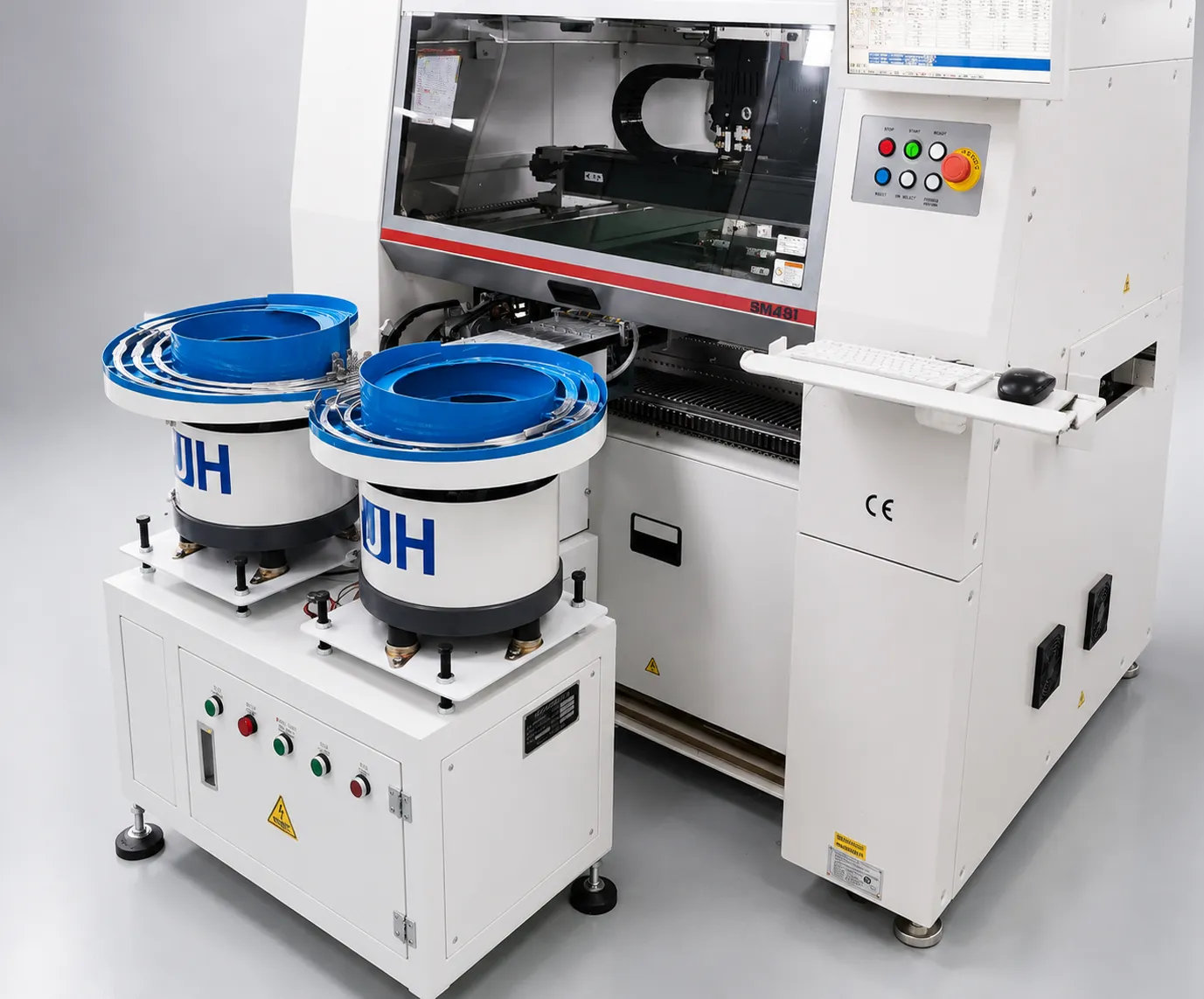
  • SMT (surface mount technology) — components are mounted directly onto the PCB surface instead of through drilled holes, which is what makes high-density boards and automated placement possible.
  • Pick-and-place (P&P) — the machine that picks components from feeders and places them on the solder-pasted board; modern mounters are rated in CPH, and high-end models place more than 80,000 CPH.
  • Feeder channel — one independent feeding lane: one lens profile, one track, one pickup position.
  • Vibratory bowl feeder — the storage and orientation device — a bowl driven by electromagnetic pulses that walks lenses up a spiral track while gates and sensors set orientation.
  • Escapement — the mechanical gate that releases exactly one lens to the pickup position per machine cycle.
  • Pickup point (pick-up platform) — the fixed location where the nozzle meets the lens.
  • UPH (units per hour) — the same throughput as CPH, normally used when the unit being counted is the lens rather than the placement.
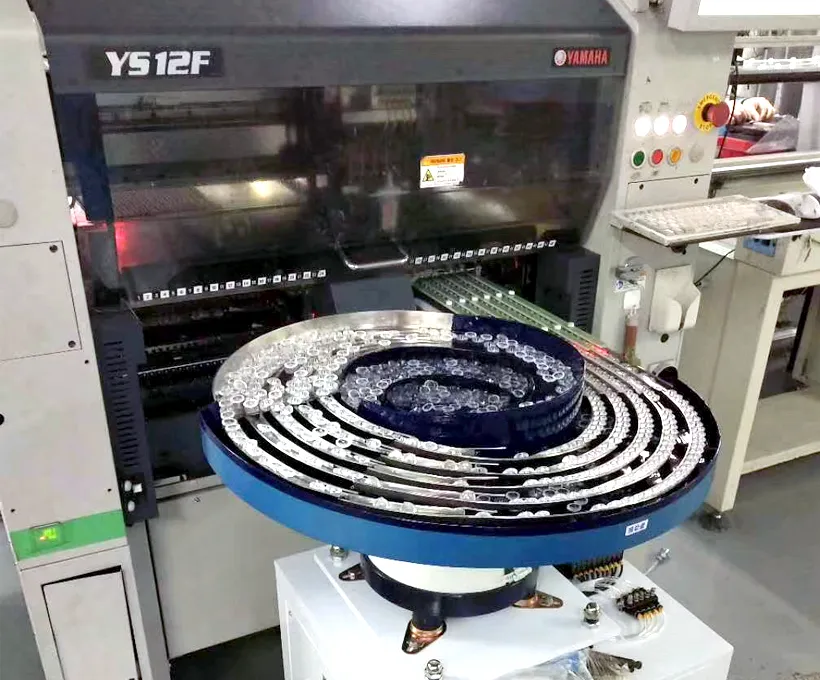
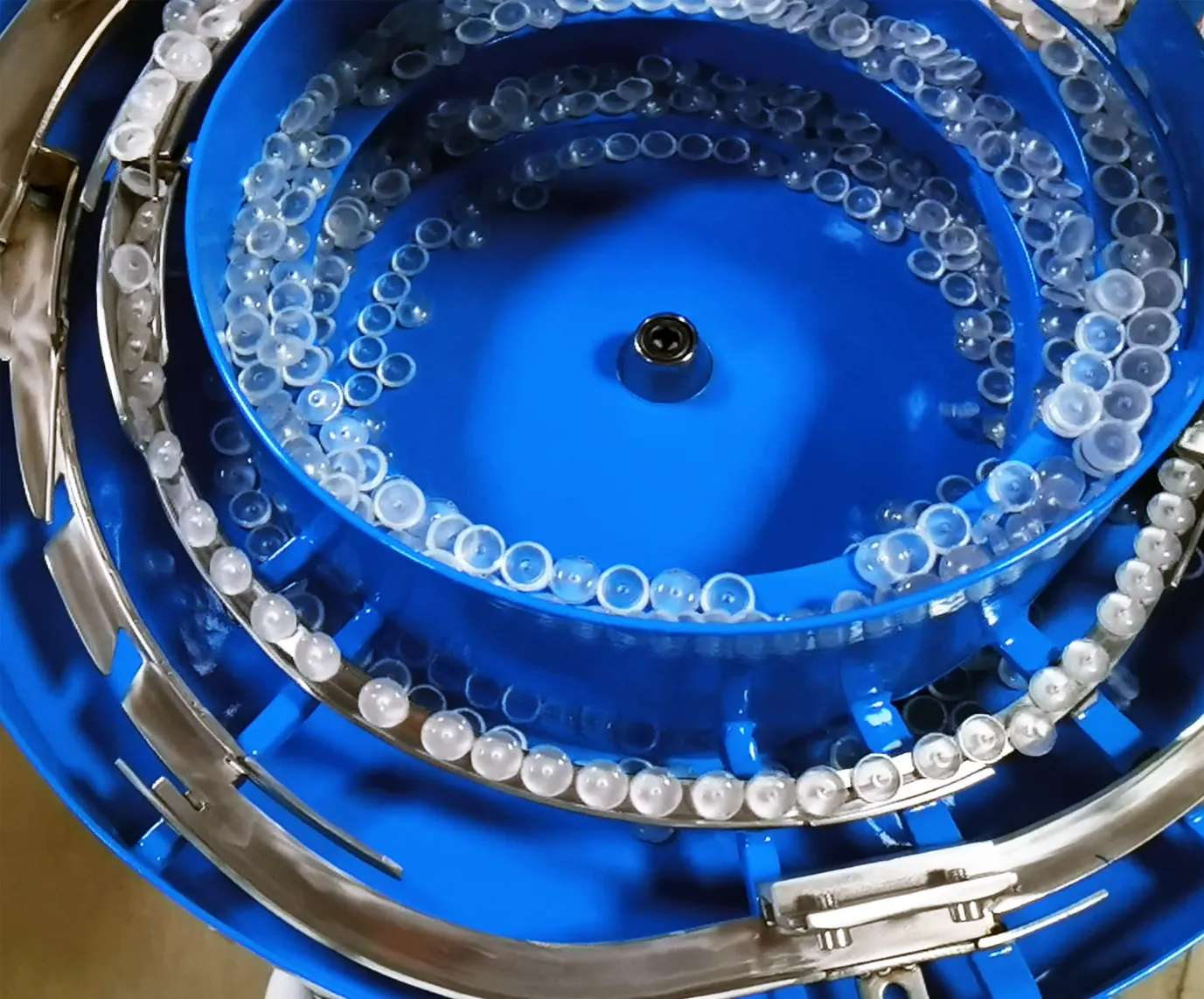
Round optical lenses circulating inside the blue vibratory bowl of a DPS-2 lens feeder
Inside the bowl: the spiral track lifts and orients each lens before it reaches the escapement.

How a Vibratory Feeder Moves and Orients Lenses

A vibratory bowl feeder converts electrical pulses into a small helical movement.

  • Drive — an electromagnetic drive at the base pushes the bowl forward and lets it snap back, so lenses walk up the internal spiral track a fraction of a millimetre at a time.
  • Orientation gates — shaped metal or nylon features that only let a correctly oriented lens pass; a lens lying flat, upside down or doubled up is pushed back into the bowl or blown off and recirculated.
  • Tooling — track, gates and orientation features engineered around one lens geometry — which is why a second lens needs a tooling change, and why tooling and lens profile are quoted together.

The linear track carries oriented lenses from the bowl to the nozzle.
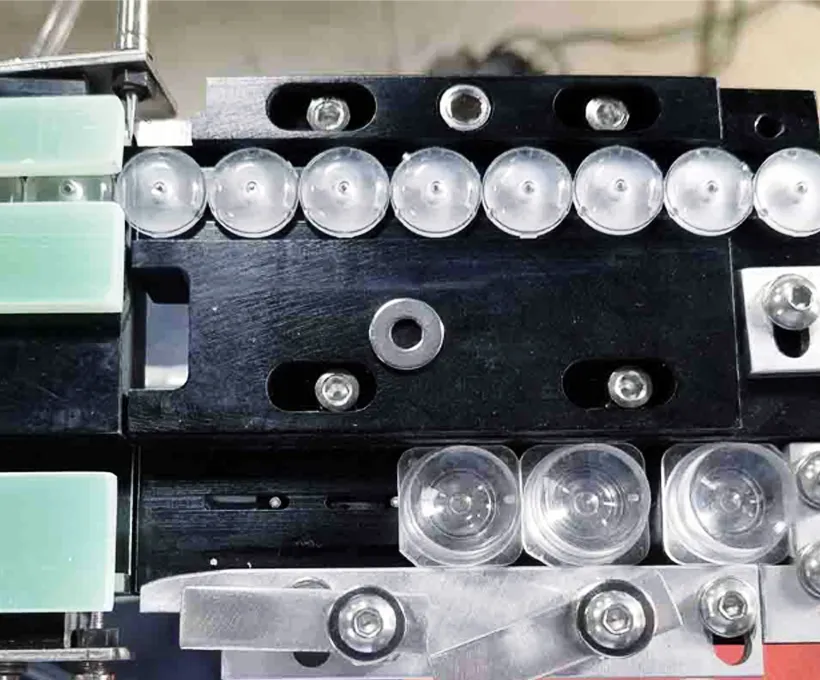
  • Linear track — the straight section between the end of the bowl and the pickup point; it buffers lenses so that the mounter never waits.
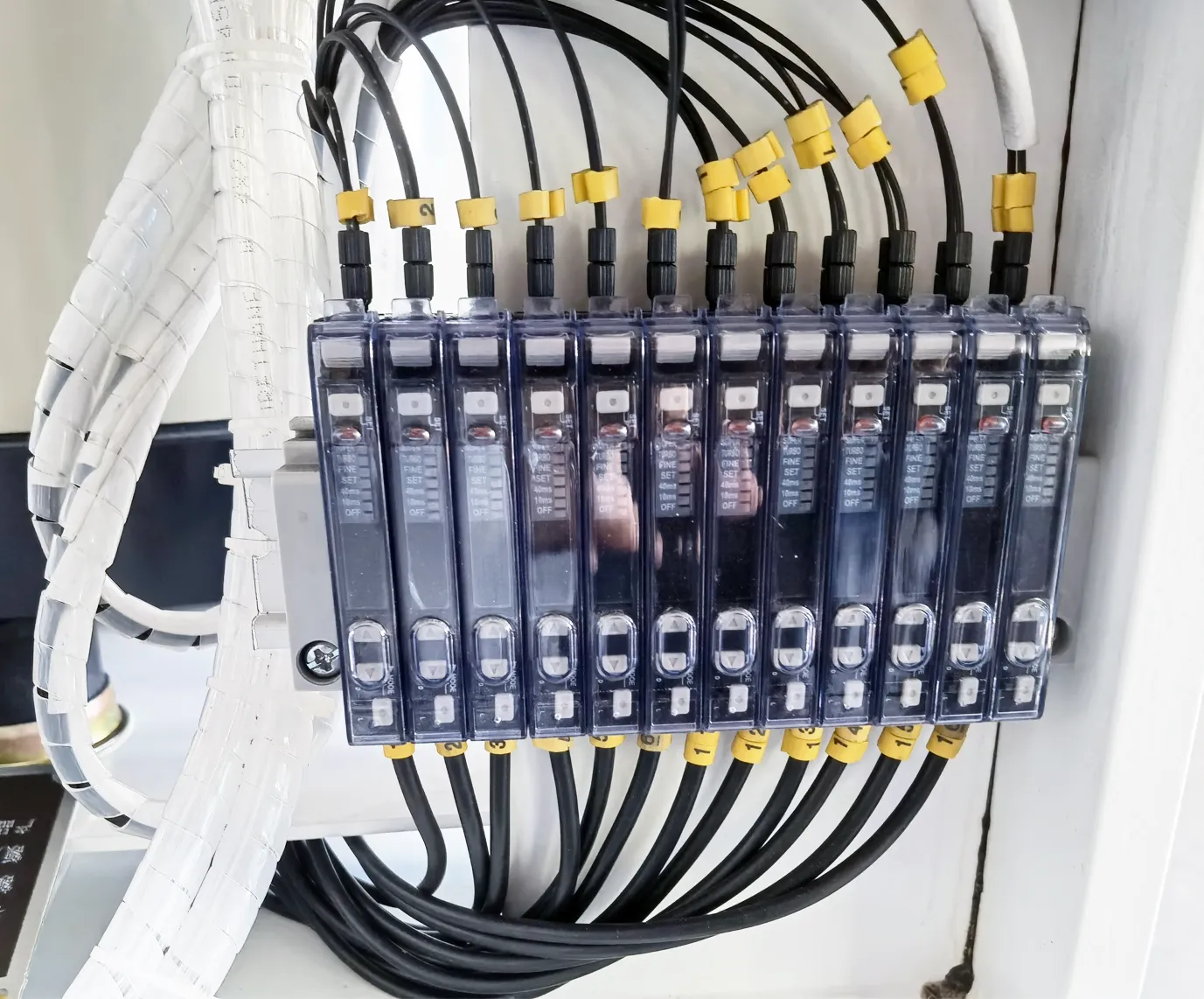
  • Fiber-optic sensors — through-beam or reflective fibers detect a lens, count it and confirm the track is full, while the controller adjusts vibration amplitude to hold a steady queue.
  • Blow-off / reject lane — removes a lens that cannot be fed upright instead of letting a bad orientation reach the nozzle.
  • What separates 3,600 UPH from a stall — track length, sensor count and gate design — the quality of this section decides whether the feeder holds rate when the bowl empties.
Close-up of the lens feed track with lenses seated in the track pockets
Close-up of the lens feed track: lenses seated in the track pockets before release.

Control and Vibration Technology Terms

Dual-frequency vibration means the bowl and the linear track are driven independently.

  • Circular drive (bulk) — on the DPS-2 a circular drive runs at 50–120 Hz to move lenses in bulk around the bowl.
  • Direct drive (alignment) — a second drive runs at 100–200 Hz to align and advance lenses on the linear track.
  • Why two frequencies — separating them removes the resonance interference that appears when one drive has to do both jobs, so the feeder runs fast in bulk and gentle in the last millimetres before pickup.
  • Amplitude — the stroke of each pulse and the practical speed control — too little and lenses stall on the track, too much and they jump over gates or collide and scratch.

The controller holds that amplitude steady as the load changes — a full bowl behaves differently from a nearly empty one.
  • PID control — proportional–integral–derivative feedback that keeps amplitude steady; the DPS-2 uses an independent PID loop per drive.
  • PLC — the industrial computer running the sequence; the DPS-2 uses a Mitsubishi FX5U and stores up to 50 lens profiles, so an operator recalls a recipe instead of retuning the machine.
  • HMI — the operator touchscreen — a 7-inch Weintek panel with six interface languages (English, Chinese, Spanish, Vietnamese, Hindi, Turkish).
  • Modbus TCP — the open protocol the PLC uses to publish cycle counts, reject counts and run status to a line computer or MES.
Fiber-optic sensor amplifier bank detecting and counting lenses on the feeder track
Sensor amplifiers: each channel reports lens presence, count and jam conditions to the PLC.

Quality and Process Metrics Terms

These are the numbers a feeding proposal is judged on.

  • Rejection rate — the share of lenses that cannot be placed or fail inspection — manual feeding typically rejects 5–15% (misorientation, double picks, handling damage), while dual-frequency automatic feeding is specified to hold rejection under 0.5%.
  • Cpk (process capability index) — how well a process stays inside its tolerance; 1.33 is the common acceptance line, and values are only meaningful when the feeder reports them per recipe.
  • OEE (overall equipment effectiveness) — availability × performance × quality; world-class performance is above 85%, and a feeder that stalls or jams pulls the whole line below that faster than any single machine defect.

Component life and process discipline are the second half of the quality picture.
  • MTBF (mean time between failures) — on the DPS-2 the Mitsubishi PLC is rated above 100,000 hours, SMC pneumatic valves above 10 million cycles and Keyence sensors above 50,000 hours.
  • SPC (statistical process control) — watching those numbers on control charts; when the feeder logs counts and rejects per shift, SPC becomes automatic rather than manual.
  • First-pass yield — the share of boards that pass inspection first time — the metric lens feeding influences most directly, because every misoriented lens that reaches the nozzle becomes rework or a scrapped lens.
  • Traceability — the link between a finished board and the feed parameters used on it.
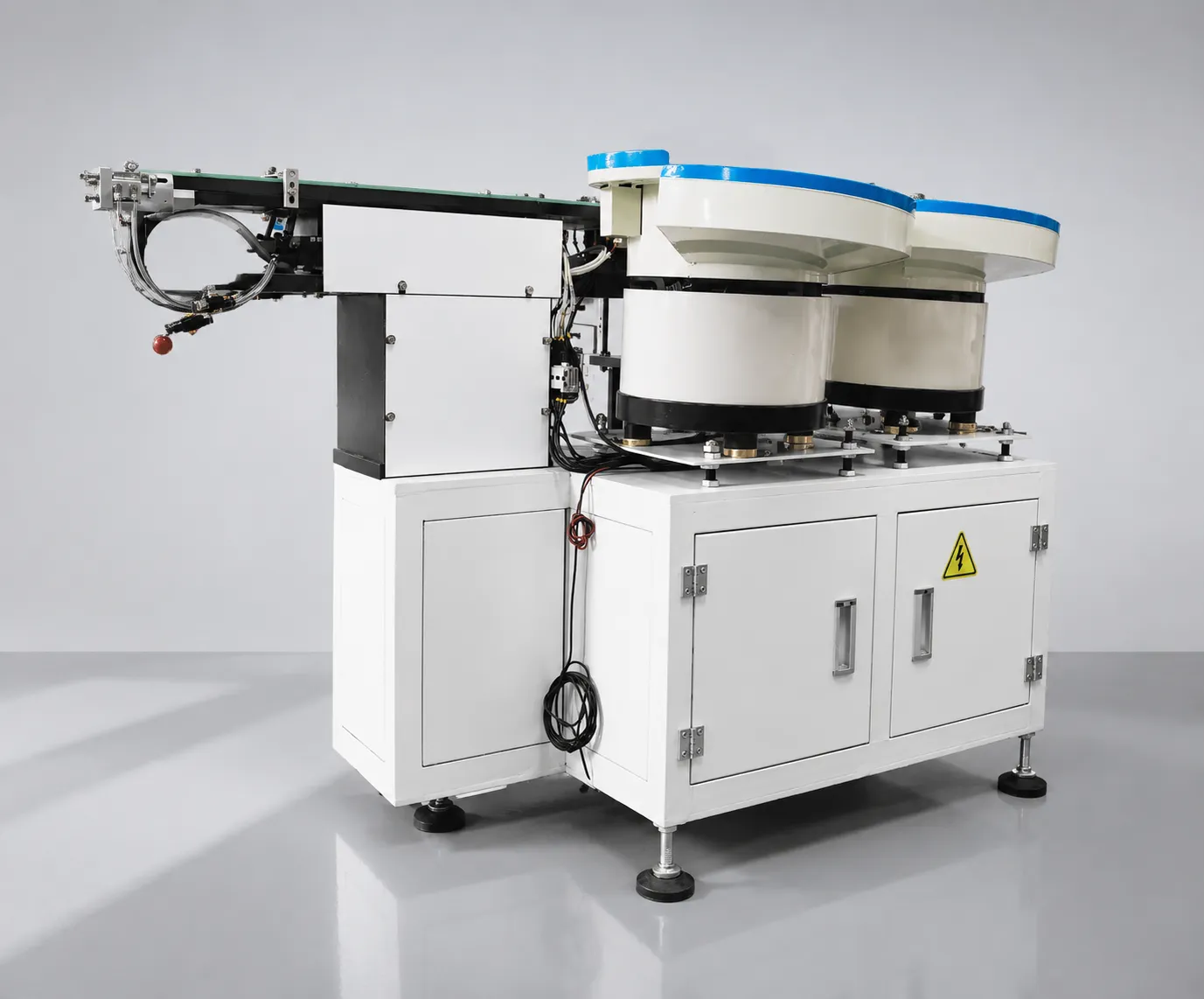
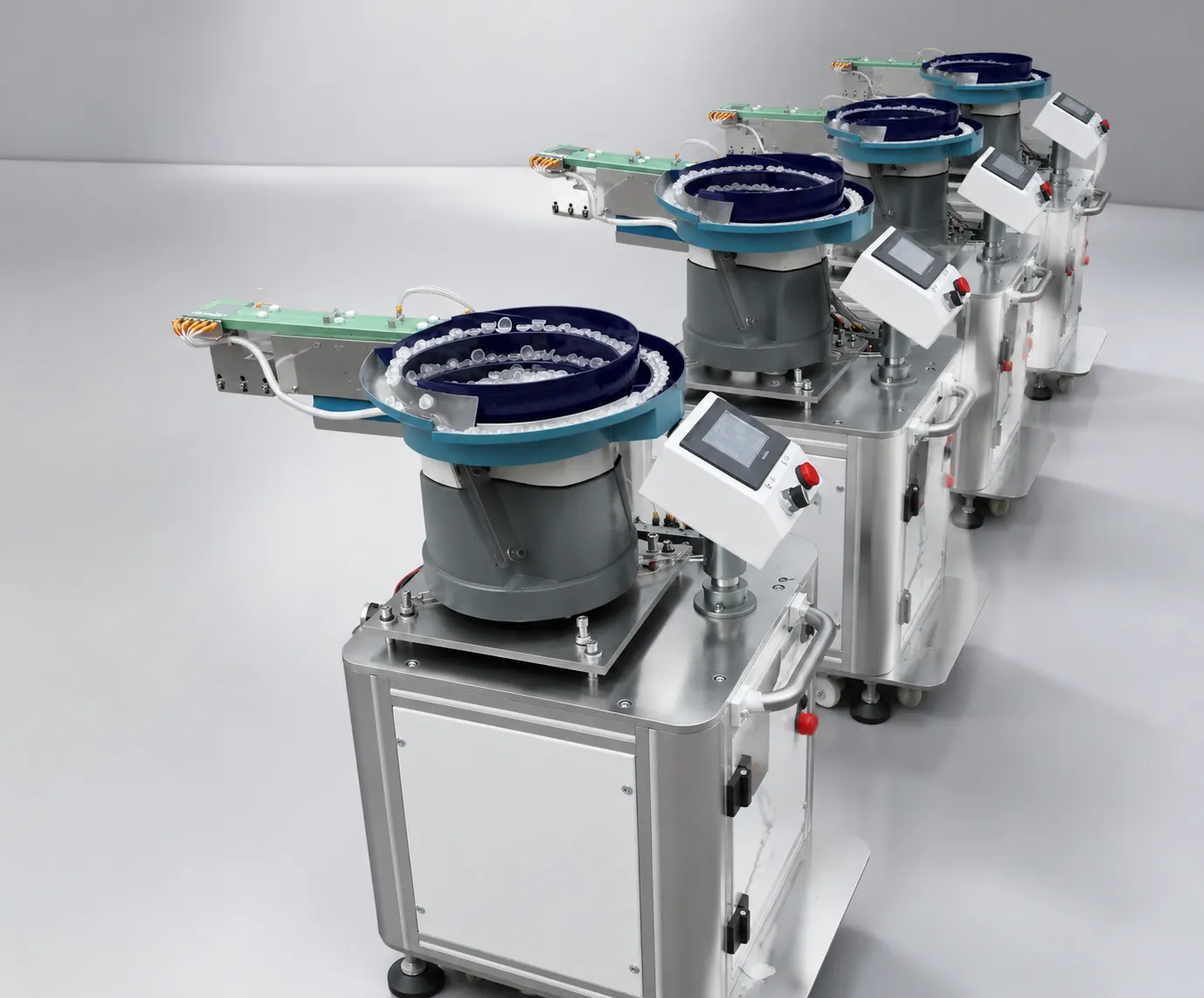
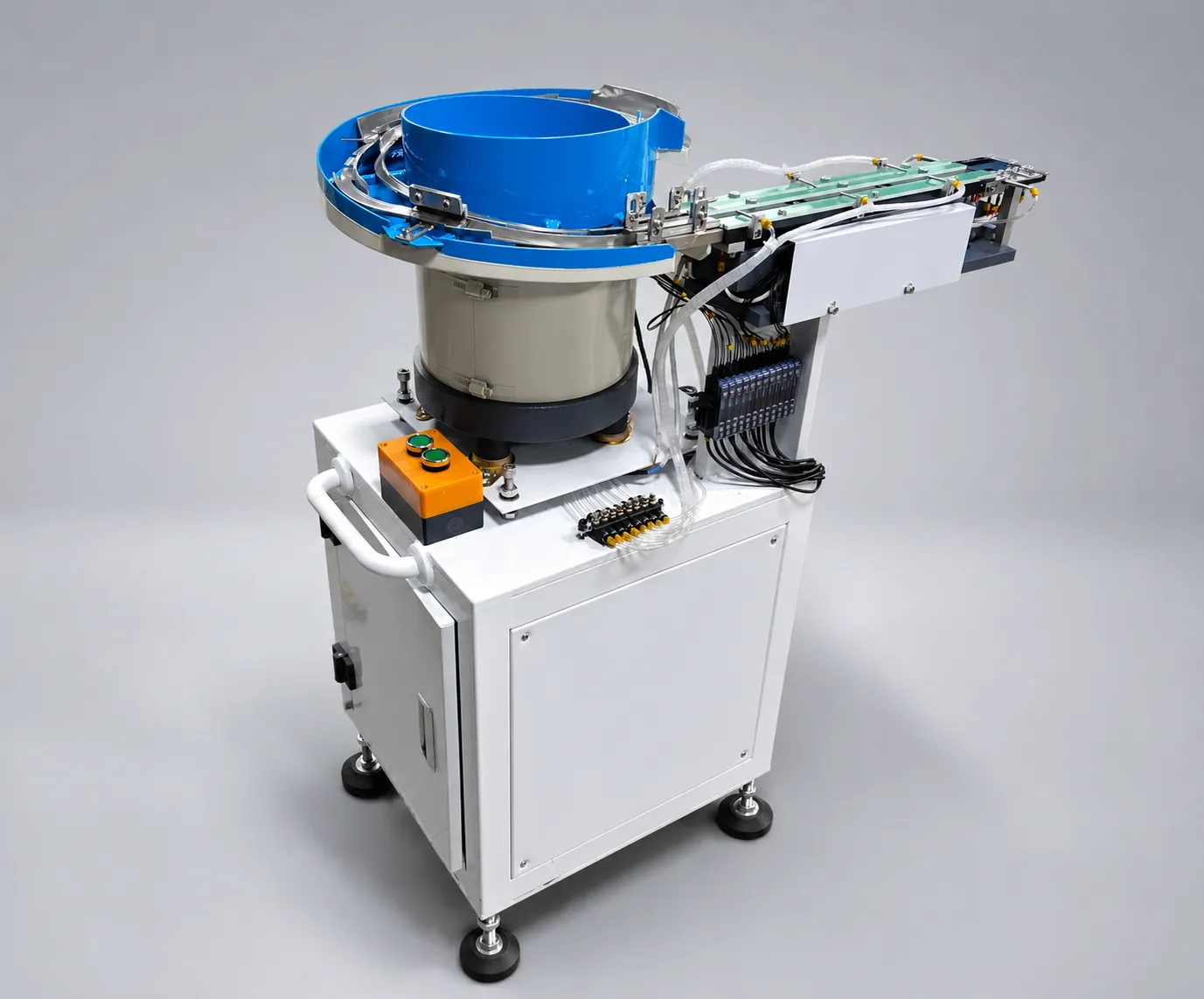
Single-bowl DPS-2 lens feeder with its discharge track and control cabinet, photographed in the studio
Single-bowl DPS-2 lens feeder: bowl, discharge track and control cabinet.

Production and Integration Terms

Changeover time is the term that decides whether automation pays on a high-mix line.

  • Changeover time — the time to switch the feeder from one lens type to another, including tooling and recipe — 15–30 minutes manually, under 5 minutes with stored recipes and tool-less quick-change tooling.
  • Lens profile — the stored description of the lens geometry the tooling is built for.
  • Recipe — the vibration parameters that were found to work for that profile.

Feeding has to be balanced against the rest of the line.
  • Line balancing — matching feeder output to mounter demand so no buffer grows empty; with 3,600–7,200 UPH per channel, one or two channels normally cover a lens-placement station.
  • MES (manufacturing execution system) — the plant software that consumes feeder data for OEE, traceability and predictive maintenance, connected over Modbus TCP.
  • ESD (electrostatic discharge) — the static risk that damages lenses and boards; an ESD-safe configuration holds surface resistance in the 10⁶–10⁹ ohm range with grounding.
  • Preventive maintenance — the scheduled interval for cleaning tracks, checking gate wear and confirming sensor alignment, which is what keeps MTBF figures meaningful in daily production.
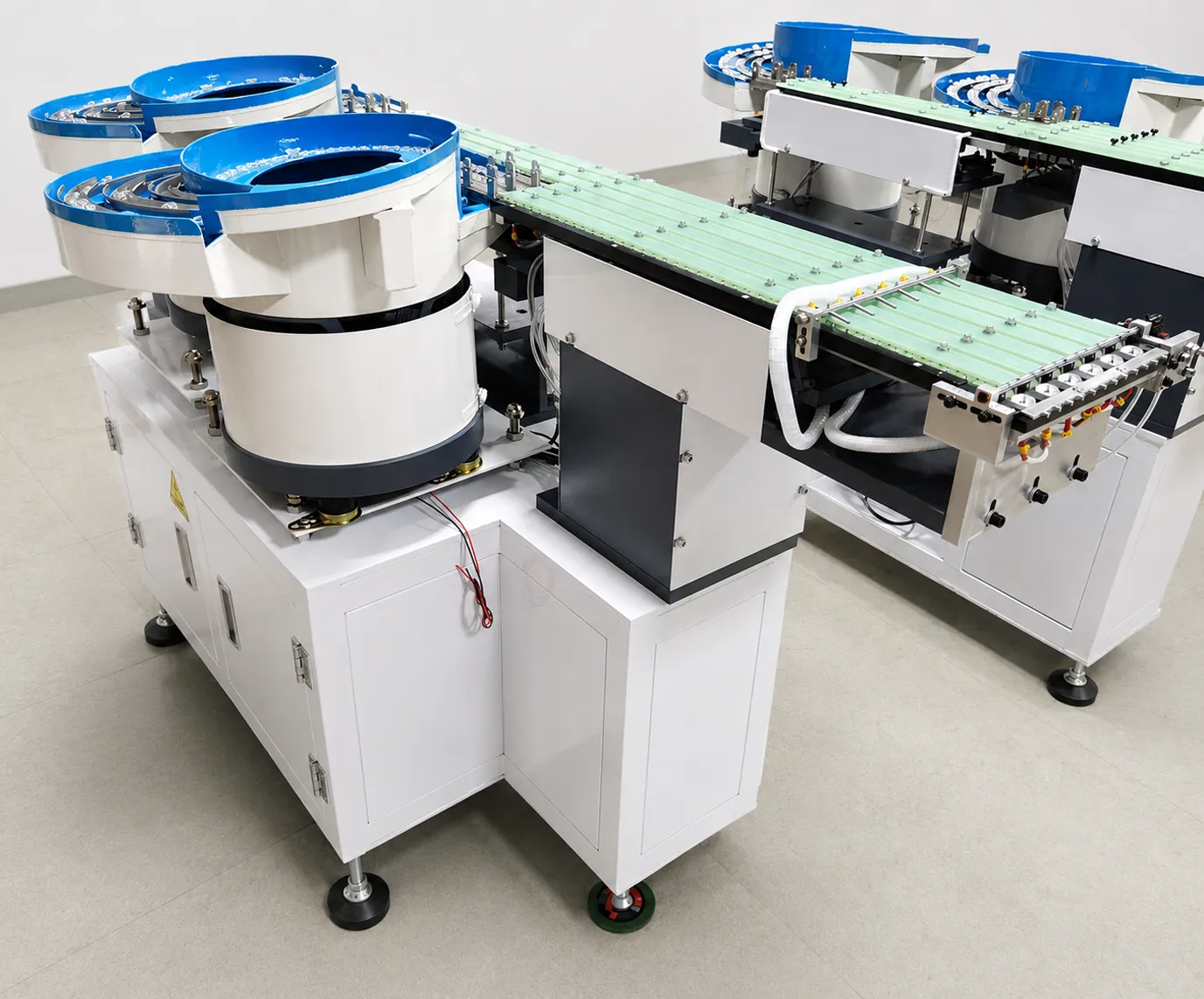
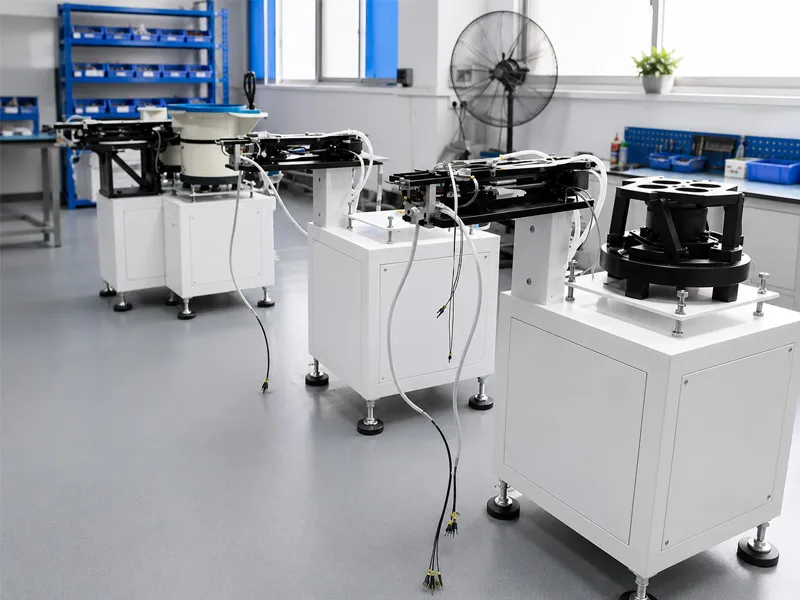
Several lens vibratory feeders assembled and tested on the workshop floor before shipment
Assembly and run-in: every feeder is tested with the customer lens before shipment.

Trade, Compliance and Logistics Terms

Trade and compliance terms appear on every quotation and on every crate.

  • IATF 16949 — the automotive quality standard — process control, traceability and defect prevention for production equipment, which in practice means documented parameters and change control for the feeder.
  • ISO 13485 — the medical-device quality standard; for medical production JHIMS supports IQ/OQ/PQ validation documentation on DPS-2 configurations.
  • ISPM-15 — the international wood-packaging standard: crates are fumigated and stamped so customs accepts them worldwide.
  • DDP (delivered duty paid) — the Incoterm under which the seller carries all costs to the destination including duties — JHIMS ships DDP to most destinations, so the price quoted is the price paid.

Commercial terms decide the real cost of ownership far more than the list price of the bowl.

  • Payment terms — 70% T/T deposit with the order and 30% before shipment, with sight L/C available for existing customers.
  • Installation and commissioning — provided by JHIMS certified engineers on site at a charge; remote video training, documentation and technical guidance are free of charge.
  • Warranty and spares — warranty covers the feeder for the agreed period, and spare parts kits — gates, track inserts, sensor fibers and air filters — are quoted with the machine so a line can be maintained without waiting for an overseas shipment.

The Terms That Decide Payback

Feeder payback comes from four numbers: throughput (manual 800–1,200 UPH vs 3,600–7,200 UPH per channel), rejection (5–15% vs under 0.5%), changeover (15–30 minutes vs under 5), and labor released from tray loading and visual checks. Across published JHIMS lens-feeding projects the combined effect lands in a 6–11 month payback, most sensitive to reject cost: a factory scrapping 10% of lenses pays back far sooner than one scrapping 2%.

Two practical terms complete the picture. A sample test — sending 500–800 lenses for a 48-hour trial run on the customer lens — is the cheapest way to verify orientation quality before committing to tooling. Acceptance criteria are the measurable conditions written into the order: throughput, rejection ceiling, alignment tolerance, changeover time and the documentation delivered at handover.

Lens Feeding Terminology Quick Reference

Use this table as a translation sheet when reading a feeder specification or a quotation. The middle column is the definition you will find in a datasheet; the right column is the reason the term appears in a commercial discussion at all.

Term What it means Why it matters
SMT Surface mount technology: components mounted directly on the PCB surface. Defines the process the feeder has to serve.
CPH / UPH Components (or units) processed per hour. The headline throughput number in any offer.
Vibratory bowl feeder Bowl driven by electromagnetic pulses that lifts parts along a spiral track. Stores, separates and orients lenses.
Linear track Straight section between bowl and pickup point. Buffers lenses so the mounter never waits.
Escapement Gate that releases exactly one lens per cycle. Prevents double picks and misfeeds.
Orientation gate Shaped feature that rejects wrongly oriented lenses. The core mechanism behind rejection rate.
Pickup point Fixed position where the nozzle meets the lens. Determines alignment tolerance in placement.
Fiber-optic sensor Optical sensor that detects and counts lenses on the track. Detects empty track and jams immediately.
Dual-frequency vibration Independent drives for bowl (50–120 Hz) and track (100–200 Hz). Speed without sacrificing orientation quality.
PID control Feedback loop holding vibration amplitude steady. Keeps output stable as the bowl empties.
PLC Industrial controller running the feeding sequence. Stores recipes and enables one-button changeover.
HMI Operator touchscreen panel. Multi-language operation and alarm visibility.
Modbus TCP Open industrial communication protocol. Connects the feeder to MES and OEE reporting.
Rejection rate Share of lenses that cannot be placed or fail inspection. Manual 5–15% versus under 0.5% automatic.
Cpk Process capability index; 1.33 is the usual acceptance line. Proves the feed is repeatable, not just fast.
OEE Availability x performance x quality; world-class above 85%. Shows what the feeder costs the line when it stalls.
Changeover time Time to switch lens type, including tooling and recipe. Manual 15–30 minutes versus under 5 minutes.
ESD-safe configuration Surface resistance held at 10^6–10^9 ohm with grounding. Protects lenses and boards from static damage.
IATF 16949 / ISO 13485 Automotive and medical quality standards. Decide documentation and validation requirements.
ISPM-15 International wood packaging standard. Crates clear customs without delay.
DDP Delivered duty paid Incoterm. One all-inclusive price to the destination.

Metric Cheat Sheet: Manual vs Automatic Lens Feeding

The table below collects the published figures that are normally quoted side by side in a feeding proposal. Treat the automatic column as the specification to be verified at acceptance, not as a marketing claim: every line can be measured on your own lens during a sample test.

Metric Manual feeding DPS-2 automatic feeding
Throughput 800–1,200 UPH 3,600–7,200 UPH per channel
Rejection rate 5–15% under 0.5%
Changeover between lens types 15–30 minutes under 5 minutes with stored recipes
Operators per feeding station 1 operator continuously none during production
Cpk 1.33 typical verified per recipe at acceptance
Placement alignment operator-dependent ±1 mm pickup alignment
Cycle time per lens manual pick and place 0.5–1 second per lens
Lens size range limited by dexterity 3–25 mm
Payback not applicable 6–11 months on published projects
Sample test not needed 500–800 lenses, free 48-hour trial

How to Use This Glossary in a Feeder Evaluation

When a feeder is offered, ask for five numbers in writing: throughput per channel in UPH on your lens, rejection rate measured in a trial, changeover time with tooling included, alignment tolerance at the pickup point, and the MTBF of the wearing components. Then ask which lens profiles are already stored in the PLC, and what happens when the track empties mid-panel — does the mounter wait, or does the feeder signal a controlled stop?

Finally, match the terms to your own data. If your line changes lens type twice a week, changeover time dominates the payback calculation. If your scrap cost per lens is high, rejection rate dominates. If you run one lens for months, throughput and uptime dominate. The glossary exists so that those three sentences can be written in the same units by both sides of the table.

Related Pages in This Knowledge Cluster

This glossary is the reference page of a four-part lens feeding cluster. Read them in order when specifying a new feeding station, or go straight to the troubleshooting guide if a feeder is already running.

  • DPS-2 product overview — what the machine is and which lenses it feeds.
  • DPS-2 FAQ — the commercial and tooling questions buyers ask first.
  • Manual vs automatic comparison — turns volume and mix into a decision.
  • Troubleshooting guide — the faults an operator meets after installation.

See the linked guides below.

Frequently Asked Questions

What is a vibratory feeder?▼
An automated device that uses electromagnetic vibration to move parts along a track, orienting them with gates and sensors before delivery to a pickup point — replacing manual part handling.
What is UPH?▼
Units Per Hour — the number of components processed in one hour. Manual lens feeding runs 800–1,200 UPH; the DPS-2 feeds 3,600–7,200 UPH per channel.
What is rejection rate?▼
The share of parts that fail placement or inspection. Manual lens feeding typically rejects 5–15%; dual-frequency automatic feeding holds under 0.5%.
What is PID control?▼
A feedback control algorithm (Proportional–Integral–Derivative) that continuously adjusts output to hold a setpoint. In feeders it keeps vibration amplitude stable despite load changes.
What is dual-frequency vibration?▼
A JHIMS-patented architecture using two independent drives — circular (50–120 Hz) for bulk movement and direct (100–200 Hz) for precision alignment — each with its own PID controller. See the technical comparison.
What is feeder tooling?▼
The custom mechanical parts — bowl insert, track, and orientation gate — matched to one specific lens geometry so the feeder can orient it reliably.
What is lens feeding in SMT?▼
Lens feeding is the process that delivers optical lenses to a pick-and-place machine already separated, oriented and queued at the pickup point. It replaces manual tray loading, which runs 800–1,200 UPH with a 5–15% rejection rate.
What is the difference between UPH and CPH?▼
Both count output per hour. CPH counts component placements and is the standard rating for mounters; UPH counts the units being fed and is normally used for a lens feeder, where one channel delivers 3,600–7,200 lenses per hour.
What is an escapement in a vibratory feeder?▼
The escapement is the gate at the end of the linear track that releases exactly one lens per machine cycle. It prevents double picks and keeps a single lens waiting at the pickup point.
What is an orientation gate?▼
An orientation gate is a shaped metal or nylon feature on the spiral track that only lets a correctly oriented lens pass. Lenses lying flat, inverted or doubled up are returned to the bowl, which is what drives the rejection rate down below 0.5%.
What does Cpk tell me about a lens feeder?▼
Cpk measures how repeatably the feeder holds its tolerance. A Cpk of 1.33 is the usual acceptance line, and because Cpk is recipe-specific it should be verified with your own lens rather than taken from a datasheet.
What is OEE and why does feeding affect it?▼
OEE multiplies availability, performance and quality; world-class performance is above 85%. A feeder that jams or empties mid-panel stops the mounter, so feeding uptime sets the ceiling for the whole line.
What is changeover time in lens feeding?▼
Changeover time is the total time to switch the feeder to another lens type, tooling and recipe included. Manual feeding needs 15–30 minutes; a PLC-controlled feeder with stored recipes and tool-less tooling does it in under 5 minutes.
What is an ESD-safe feeder configuration?▼
It is a feeder built and grounded so that surface resistance stays within the 10^6–10^9 ohm range, protecting lenses and boards from electrostatic discharge during feeding and placement.
What is ISPM-15 and why does it matter?▼
ISPM-15 is the international standard for wood packaging. JHIMS crates are fumigated and stamped accordingly, so the machine clears customs in most countries without extra treatment.
What is DDP and does JHIMS ship DDP?▼
DDP (delivered duty paid) means the seller carries all costs to the destination, including duties. JHIMS ships DDP to most destinations, so the quoted price is the price paid.
What are JHIMS payment terms?▼
Standard terms are 70% T/T deposit with the order and 30% T/T before shipment. Existing customers may use an L/C at sight.
Is installation and operator training included?▼
JHIMS provides on-site installation, commissioning and operator training by certified engineers — on-site service is available at a charge. Remote video training, documentation support and technical guidance are free of charge.
What is a sample test and how many lenses are needed?▼
A sample test is a trial run of your lens on the feeder before tooling is committed. JHIMS runs 500–800 lenses in a free 48-hour test and reports orientation quality and throughput.
What lens sizes can a DPS-2 feeder handle?▼
The DPS-2 is built for optical and LED lenses from 3 mm to 25 mm across, with tooling matched to the specific lens geometry. A lens outside that band is handled as a custom tooling project.
How many feeders does one line need?▼
Match channel output to mounter demand: with 3,600–7,200 UPH per channel, one or two channels usually cover a lens placement station. High-mix lines add channels to avoid changeover at every lens switch.
What is MTBF and which parts matter most?▼
MTBF is the mean time between failures, used to compare component life. On the DPS-2 the PLC is rated above 100,000 hours, SMC valves above 10 million cycles and Keyence sensors above 50,000 hours.
What is Modbus TCP used for on a feeder?▼
Modbus TCP is the open protocol the feeder PLC uses to publish cycle counts, reject counts and run status to a line computer or MES, which is how OEE and traceability reporting become automatic.
What is IATF 16949 and does it affect a feeder purchase?▼
IATF 16949 is the automotive quality standard. It requires process control, traceability and defect prevention for production equipment, so documented parameters and change control are part of the specification rather than an extra.
How does the feeder signal a jam?▼
Fiber-optic sensors on the linear track watch lens presence and flow. If the track empties or a lens stops moving, the controller raises an alarm on the HMI and reports the condition over Modbus TCP instead of letting the mounter wait indefinitely.
Does the feeder need regular maintenance?▼
Yes. Tracks, gates and sensor fibers are wear items: scheduled cleaning and gate inspection keep the published MTBF figures meaningful, and spare kits are quoted with the machine so a line can be maintained without waiting for overseas shipment.

Have a Term to Suggest?

Contact our engineers to suggest a term for this glossary, or ask about lens feeding automation for your line.

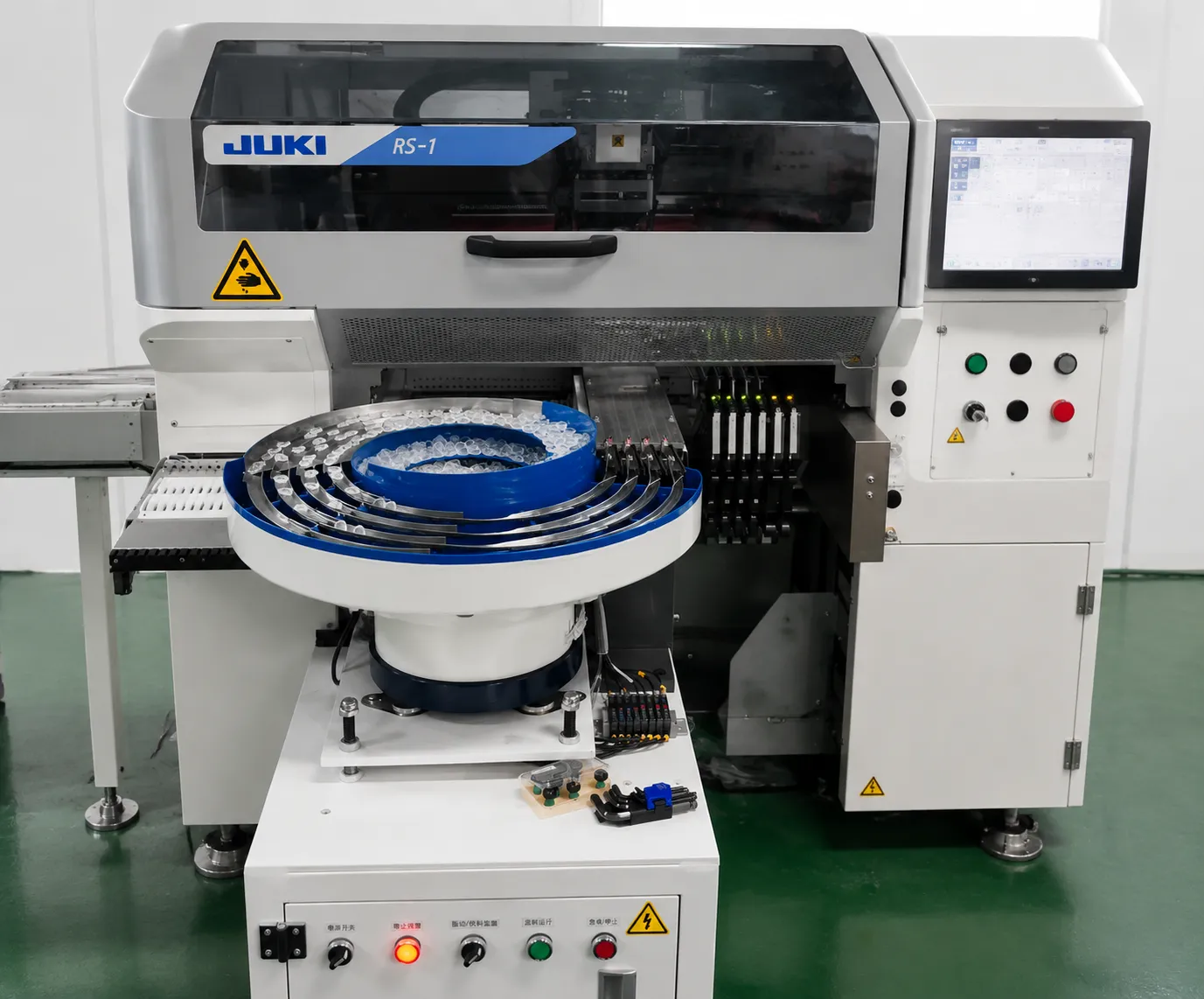
These terms in practice: watch the lens vibratory feeder on a pick-and-place machine and automatic LED lens feeding in production. More machine and factory footage is on the JHIMS YouTube channel.


📞 (86-755) 86700443✉ [email protected]